
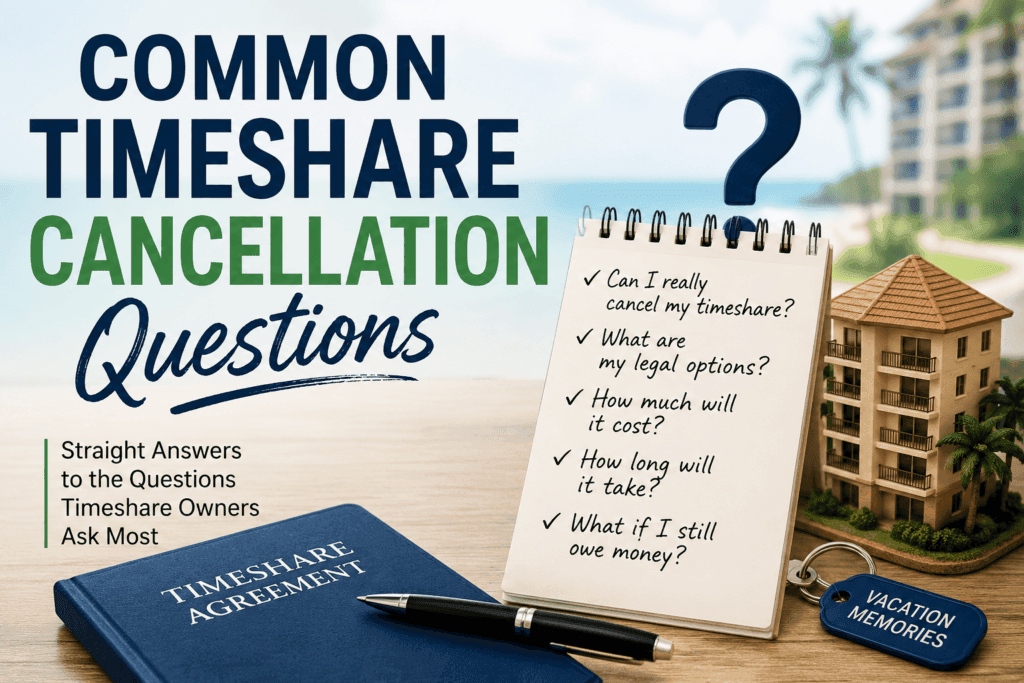
If you own a timeshare and you’ve ever searched for answers online, you’ve probably landed in a Facebook group or a forum thread full of owners asking each other the same handful of questions. I see the same questions over and over, and I understand why — nobody explains this stuff to you when you sign the paperwork.
Moreover, I spent more than 25 years inside the timeshare industry, working in sales, marketing, contracts, and management across the United States, Mexico, Jamaica, the Dominican Republic, and the Caribbean. I know what owners are told at the point of sale because I was often the one saying it. At some point I got uncomfortable with parts of what I saw happening to buyers, and I left the industry to do something different: help owners understand their contracts and their real options, without the pressure.
I wrote a book about it, “Everything About Timeshares: Before, During and After the Sale,” and I now spend my time answering exactly the kind of questions below. Here are the ones I hear most often, answered as plainly as I can.
“Can I just stop paying my maintenance fees?”
You can stop paying, but it’s rarely a clean exit. If your timeshare is paid in full and there are no fees owed, you can cancel with the right set of cancellation documents and process. If there is a balance wed, most timeshare contracts allow the resort or HOA to send your account to collections, report delinquency, and in some cases pursue foreclosure on the timeshare interest — the specifics depend entirely on your contract and the state or country where the property is located. Walking away without a plan can create bigger problems than the timeshare itself, so before you stop paying anything, it’s worth understanding what your specific contract actually allows the resort to do.
“Will canceling my timeshare hurt my credit?”
It depends on how the cancellation happens. If your timeshare is paid in full, it should not impact your credit. Also, a rescission during your legal cancellation window (if you’re still inside it) typically has no credit impact at all. But if a timeshare goes to collections or foreclosure because payments stopped, that can absolutely show up on your credit report. This is another area where “it depends on your contract” is the honest answer, not a dodge — the loan terms, the state, and the resort’s own policies all play a role.
“Do I need a lawyer to cancel my timeshare?”
Not always, but sometimes it helps, and sometimes it’s overkill for what you actually need. Paid in full timeshares are straightforward enough to handle with the right documents and a clear understanding of your contract terms; others involve more complicated ownership structures or disputes where legal counsel makes sense. I’d rather tell you honestly that it depends than sell you services you don’t need — that’s part of why I offer a free contract review, so you can find out which category you’re in before spending money.
“Is my timeshare actually worth anything?”
For most owners, the resale value is much lower than what they paid, and in a lot of cases it’s close to nothing on the open market — that surprises people, but it’s the reality of how timeshares are priced and sold. I go into this in more detail in what your timeshare is really worth, because understanding actual market value changes how people think about their exit options. It’s worth reading before you decide whether to try selling, gifting, or canceling.
“What’s the difference between canceling and reselling my timeshare?”
Canceling means ending your ownership and your future obligations, usually through a legal exit process tied to your contract. Reselling means trying to find a buyer to take over the ownership and the fees — which, given how little resale demand exists for most timeshares, is harder than people expect. I wrote a full comparison in timeshare cancellation vs. resale that walks through when each approach actually makes sense.
“How long does timeshare cancellation take?”
If your timeshare is paid in full, your cancellation is legally processed once the resort receives your cancellation documents. Most do not respond when they receive these documents and owners do not have to wait for their approval. There’s no single timeline, because it depends on your contract, the developer, and which method you use to exit. Some rescission-period cancellations resolve in weeks; other paths take considerably longer. Anyone who guarantees you a specific number of days without having looked at your paperwork is guessing, and I’d be skeptical of that kind of promise.
“Can I get out of my timeshare if I still owe money on it?”
Owing money doesn’t automatically block you from pursuing an exit, but it does add a layer of complexity, since the loan and the ownership are often tied together in the contract. What’s actually possible depends heavily on your specific loan terms and where you are in the payment schedule. This is exactly the kind of detail a contract review is meant to sort out rather than guess at.
“Are timeshare exit companies a scam?”
Some are legitimate, some are not, and the industry has earned a reputation problem because of the bad actors — companies that take large upfront fees and deliver little or nothing. That doesn’t mean every exit company is dishonest, but it does mean you should look closely at who you’re working with, what exactly they do for the fee, and whether they’ll explain their process before you pay anything. I’d rather you ask hard questions of anyone you’re considering, including me.
“What happens if I just walk away from my timeshare?”
It depends on your contract and the resort’s practices, but “walking away” is not the same as the obligation disappearing. Fees can keep accruing, accounts can go to collections, and depending on the ownership structure there may be other consequences. Before treating a timeshare as something you can simply ignore, it’s worth understanding what your agreement actually says happens next.
One thing owners sometimes get pulled into around this point is a resort’s offer to convert their deed into a points-based membership, often pitched as a way to “reduce fees” or “get out from under” the old contract. I’d read the deed-to-points conversion pitch before agreeing to anything like that — it’s rarely the fee relief or exit it’s presented as.
“Is there a cheap, legitimate way to do this myself?”
For some owners, yes — if your situation is relatively straightforward, a DIY approach can be far less expensive than hiring a full-service exit company. I break down what that actually looks like in the cheapest way to cancel a timeshare. It’s not the right fit for every contract or every owner, which again comes back to understanding your specific paperwork before choosing a path.
Where to go from here
I built this site because I got tired of watching owners get either pressured into buying more or scared into paying for services they didn’t need — I saw both happen from the inside. My goal isn’t to tell you there’s one right answer or to promise a guaranteed outcome, because I can’t honestly say that without knowing your contract.
If you want to start for free, my consultation is a straightforward contract and exit review — no pressure, no obligation. If you’d rather learn at your own pace first, my $39 book covers what I’ve learned over 25-plus years in the industry. For owners who want more structure, there’s a $397 DIY course and a $499 DIY document-builder app that walks you through preparing your own paperwork. And for paid-in-full owners who want it handled professionally, I offer document preparation service starting at $1,500, up to $2,500 for more complex cases.
Whatever you choose, choose it because you understand your options — not because someone made you feel like you had no choice at all.