
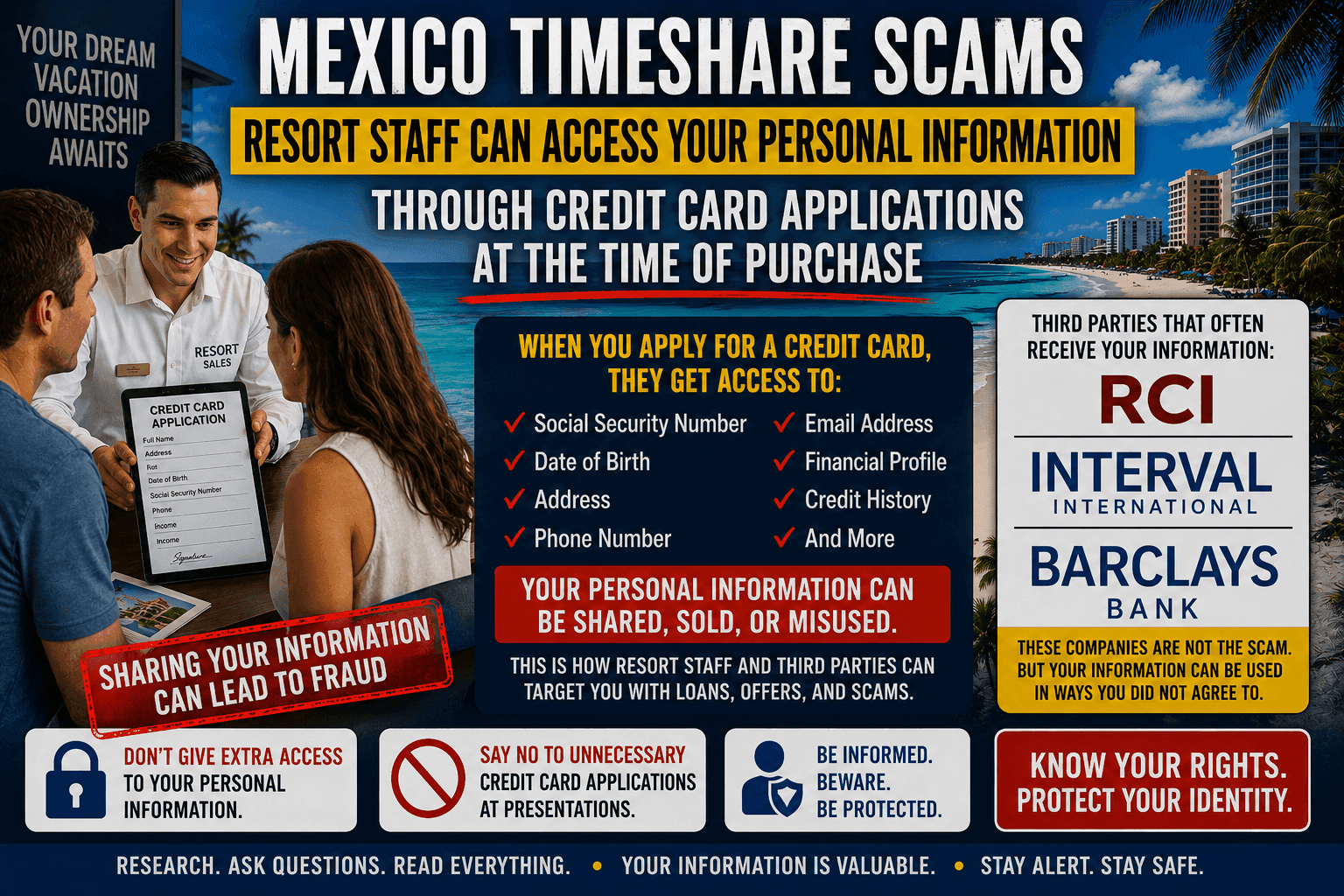
Mexico timeshare scams are changing. And one of the most disturbing problems I have encountered involves something far more serious than a misleading sales presentation: the potential misuse of a vacation club owner’s personal and financial information.
My name is Wayne C. Robinson. I spent 25 years working inside the timeshare and vacation club industry in the United States, Canada, Mexico, and the Caribbean.
I worked in timeshare sales, contracts, management, and as a Director of Sales and Marketing.
Today, I help educate consumers about Mexico timeshare scams, Mexico vacation club cancellation, and how the industry actually operates behind the scenes.
There is one issue Mexico vacation club owners need to understand:
Could Your Mexico Timeshare Information Be Used Against You?
Many Americans and Canadians purchase vacation club memberships while vacationing in places such as Cancun, Riviera Maya, Cabo San Lucas, Puerto Vallarta, and other Mexican resort destinations.
During the sales process, buyers may provide significant amounts of personal information.
That can include information required for financing or a credit-card application.
Then something strange happens.
Months or even years later, the owner receives an unexpected telephone call, email, or message from someone claiming to know about their Mexico timeshare.
The caller may already know:
- The resort or vacation club you purchased
- Approximately when you purchased it
- Details about your membership
- Information about what you paid
- Other information that makes the caller appear legitimate
The caller may claim they have a buyer for your timeshare.
They may offer to rent it, may say you’re entitled to money from a settlement or may claim to represent a government agency, law firm, resale company, or recovery service.
Eventually, however, they want something from you.
Usually money.
Before doing anything, ask one question:
How did these people get my information?
That question may expose an entirely different type of Mexico timeshare scam.
Mexico Timeshare Identity Theft: When the Scam Becomes More Serious
There is an enormous difference between receiving a random telemarketing call and being contacted by someone who possesses private information connected with your vacation club purchase.
If personal information was improperly obtained, transferred, sold, stolen, or used to facilitate fraud, the situation could potentially involve identity theft or other violations of law.
This is why Mexico timeshare owners should pay close attention to exactly what information an unexpected caller knows.
Don’t assume the caller is legitimate simply because they know the name of your resort.
In fact, their knowledge should make you ask more questions — not fewer.

The Mexico Timeshare Credit Card Connection
This is where my experience inside the timeshare industry becomes particularly important.
During some vacation club sales presentations, consumers may be encouraged to apply for financing or a credit card to help complete their purchase.
That application may require highly sensitive personal information.
In many cases, this credit application is processed through RCI or Interval International, working with a financial partner such as Barclays Bank, as part of the vacation club’s exchange program.
To be clear: RCI and Interval International are not responsible for what happens next. These are legitimate companies, and the application process itself is standard.
The concern I’ve seen involves what happens at the resort, before that application ever reaches RCI, Interval International, or the bank. Some resort staff make copies of passports, IDs, and other personal documents during this process — often without the owner’s full knowledge — and that information can end up being misused later.
If you complete a credit application during a Mexico vacation club presentation, you should know:
- Who is actually requesting the information?
- Which financial institution is receiving it?
- Who is authorized to see it?
- Where is the information being transmitted?
- Is the resort permitted to retain it?
- Could another company have access to it?
Those questions become extremely important when a Social Security number or other sensitive financial information is involved.
Never Give Your Social Security Number Without Knowing Exactly Who Is Receiving It
Being in Mexico doesn’t mean you should stop following the same identity-protection practices you would use at home.
If someone asks for your Social Security number during a Mexico timeshare or vacation club transaction, determine exactly why it is needed and who will receive it.
There may be a legitimate reason for a U.S. financial institution to request identifying information as part of a credit application.
That does not mean every person involved in the vacation club sales process should have unrestricted access to that information.
Know the difference.
Does RCI or Interval International Steal My Timeshare Owners’ Information?
No. RCI and Interval International are legitimate, well-established timeshare exchange companies, and I have no evidence that either company steals or misuses owner information.
The problem I’ve observed happens earlier in the process — often at the resort, before an application ever reaches RCI, Interval International, or their banking partner.
Some resort staff make copies of passports, government IDs, and other personal documents during the credit application process. Owners aren’t always told this is happening, and they aren’t always told why.
That’s the gap worth understanding: the companies processing the legitimate application are not the same as the resort staff handling your documents in the room.
If you applied for a credit card through RCI or Interval International during a Mexico vacation club presentation, it’s worth asking yourself:
- Did resort staff photograph or photocopy your passport or ID?
- Were you told exactly why they needed it?
- Did you ever confirm where those copies went afterward?
If the answer to any of those is “I don’t know,” that’s worth looking into — not because RCI or Interval International did anything wrong, but because you deserve to know what happened to your documents.
Warning Signs of a Mexico Timeshare Scam
Be especially cautious when someone unexpectedly contacts you and:
- Already knows details about your Mexico vacation club
- Claims someone wants to purchase your membership
- Promises an unusually large payment
- Says you must pay taxes or fees before receiving money
- Pressures you to act immediately
- Requests additional personal information
- Wants wire transfers or other difficult-to-reverse payments
- Claims to represent an organization you never contacted
And remember:
Knowing details about your timeshare does not prove the caller is legitimate.
It raises another question:
Where did they obtain those details?
What Should You Do If You Suspect Timeshare Identity Theft?
If you believe information connected with your Mexico vacation club purchase has been compromised, don’t panic — but don’t ignore it.
Document everything.
Save emails, telephone numbers, text messages, letters, contracts, credit applications, receipts, and other communications.
Write down exactly what the caller knew about you.
Contact the financial institution connected with the account or application and explain what happened.
Check your credit reports for accounts or activity you don’t recognize.
Follow the current identity-theft procedures recommended by the major credit bureaus and appropriate government agencies.
And if significant financial fraud has occurred, consider obtaining advice from a qualified attorney or appropriate law-enforcement or consumer-protection authority.
Why Some Timeshare Exit Companies May Not Recognize This Problem
Most timeshare cancellation companies are not former timeshare sales executives.
Their business is helping people exit timeshares.
That’s different from understanding how the industry operates from inside the sales room.
I spent 25 years inside the timeshare and vacation club industry.
I worked in the United States, Canada, Mexico, and the Caribbean in sales, contacts, and became a Director of Sales and Marketing.
Moreover, I know what happens before the consumer walks into the sales room, what happens during the presentation, and what happens after the contract is signed.
That background matters when investigating unusual Mexico vacation club scams because sometimes the most important question isn’t simply:
“How do I cancel my Mexico timeshare?”
It’s:
“What actually happened during this transaction?”
Mexico Vacation Clubs Are Not Necessarily the Same as U.S. Timeshares
This is another important distinction.
A Mexico vacation club membership should not automatically be treated exactly like a deeded timeshare purchased in the United States.
The structure of the membership, contract language, financing, governing law, and companies involved can differ.
That means consumers should be cautious when someone gives them a universal answer about what will happen if they cancel or stop paying.
Your contract and individual circumstances matter.
Can You Cancel a Mexico Timeshare Yourself?
In some circumstances, owners can pursue Mexico timeshare cancellation themselves rather than immediately paying thousands of dollars to a timeshare exit company.
Education is the key.
You need to understand what you purchased, what your contract says, what documents you need, where communications should be sent, and how to document everything you do.
That’s one reason I created training specifically for owners of Mexico timeshares and vacation clubs.
Learn how other owners are pursuing Mexico timeshare cancellation themselves:
http://www.timesharecancellationmastery.com
What My Students Say About Mexico Timeshare Cancellation
One of my students, Mindy Kay, wrote:
“Thank you SO MUCH Wayne! Two months after taking your Udemy course, my Mexico timeshare is canceled. It was as easy as you said it would be.”
Eric Baxter wrote:
“I wish I would have had this course BEFORE going to Mexico!”
Timeshare owner advocate and blogger Irene Parker wrote:
“Wayne Robinson is a former timeshare sales agent and executive who worked through Mexico and the Caribbean islands. He is an absolute expert in foreign bought timeshares.”
Another student, Wendy B., described the training as “super informative” and said she felt “less stressed and more empowered.”
That empowerment is important.
Timeshare owners make better decisions when they understand how the industry actually works.
Who Is Wayne C. Robinson?
I’m Wayne C. Robinson, a former licensed real estate and timeshare sales professional, former timeshare executive, author, educator, and consumer advocate.
I spent 25 years working professionally inside the timeshare and vacation club industry across the United States, Canada, Mexico, and the Caribbean.
I’m also the author of Everything About Timeshares: Before, During, and After the Sale.
My background includes degrees in mass communications and sales and management, along with service as a U.S. Navy journalist.
Today I use that combination of industry experience, research, writing, and consumer education to explain subjects that many timeshare owners have difficulty finding reliable information about online.
And that includes the emerging problem of Mexico timeshare scams and potential misuse of owners’ personal information.
Watch: Mexico Timeshare Scams and Identity Theft
In my video, I explain how this problem can happen and what consumers should look for.
00:00 – Introduction
00:31 – Mexico vacation clubs and U.S. credit reports
00:45 – Mexico timeshare identity-theft concerns
01:43 – Mexico timeshare cancellation options
02:06 – Understanding potential consequences of cancellation
02:19 – How personal information can potentially be compromised
03:15 – Personal information reaching another entity in the United States
04:30 – Protecting your Social Security number
05:20 – Steps to consider if you suspect identity theft
05:40 – My recommendations for protecting yourself
The Question Every Mexico Timeshare Owner Should Ask
If someone contacts you unexpectedly about a Mexico timeshare or vacation club and already knows information about your ownership, don’t automatically trust them.
Don’t give them additional personal information.
Don’t send money simply because they sound convincing.
Instead, ask:
“How did you get my information?”
Then document their answer.
Timeshare fraud continues to evolve, and consumers need to evolve with it.
The answer isn’t fear.
It’s information.
My goal with Everything About Timeshares is to give consumers something very difficult to obtain elsewhere:
Information from someone who actually worked inside the timeshare industry and understands how these transactions operate from the other side of the sales table.
If you own a Mexico timeshare or vacation club, share this article with other owners.
It could prevent someone from becoming the next victim of a Mexico timeshare scam.
Want to Learn How to Cancel a Mexico Timeshare?
Learn how other owners are pursuing cancellation themselves:
http://www.everythingabouttimeshares.com
Subscribe to Everything About Timeshares, turn on notifications, and share this information with other Mexico timeshare and vacation club owners.